In urban hospitality, the word privacy appears frequently. However, it is not always backed by structure. Real privacy does not depend on a commercial statement, but on coherent architectural and operational decisions.
In capitals such as Bogotá, Panama City or San José —where the financial districts concentrate constant activity— the exhibition is part of the environment. The premium residence must act as a counterpoint.
Privacy is not promised. It is designed. and it operates.
Design and operation as control layers
Privacy is not a single element. It is the sum of layers that work in a coordinated way.
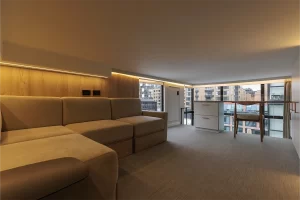
1. Architecture that reduces exposure
Spatial design directly influences the level of discretion.
- controlled and defined access.
- limited internal circulations.
- Clear separation between private spaces and common areas.
In hotel models with high rotation, the constant flow of guests increases exposure. In a directly operated residence, the transit is more contained.
The architecture sets the first control layer.
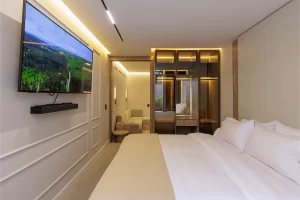
2. Interior distribution that protects routines
An executive stay involves strategic calls, revision of sensitive information and moments of deep concentration.
The interior layout must allow:
- workspaces without external interference.
- Isolated rest areas of main accesses.
- Visual control from the inside to the outside.
In a furnished apartment in the financial district, these decisions make the difference between nominal privacy and functional privacy.
3. Direct operation and structural discretion
The second layer of control is operational.
When management is fragmented — owner, external administrator, intermediary platform — information and processes are distributed among multiple actors.
In a direct operating model under standards like The Vetra Standard™, the chain of responsibility is unique. This allows:
- clear access protocols.
- Discreet handling of data and communication.
- Structured support without unnecessary exposure.
Privacy is also a question of who has control of the system.
4. Consistency that prevents visible friction
Privacy is compromised when there are operational failures: incorrect access, imprecise coordination, unexpected interventions.
Preventive maintenance and continuous monitoring reduce these risks.
In a premium residence, the absence of incidents is no coincidence. It is the result of defined processes.
Discretion is not improvised.
Privacy as operational trust
On executive trips, privacy is not just convenience. It is a professional requirement.
Corporate teams, regional managers and international consultants require environments where:
- information is handled with care.
- interaction is minimal and structured.
- The environment does not expose personal routines.
In areas such as the business north of Bogotá or the banking area of Panama City, external activity is intense. The interior should offer stability.
The well-designed privacy allows the guest to operate with peace of mind.
Beyond silence: comprehensive control
Silent luxury is not isolation. It is control.
control over:
- who accesses the space.
- How information is managed.
- What level of interaction occurs during the stay.
A directly operated residence integrates design and operation as a single system. That integration builds real privacy.
In the category of operational confidence, privacy is one of the least visible and most decisive pillars.
Comparison: Declared Privacy vs. Privacy Designed
| declared privacy | Designed privacy |
| commercial message | Integrated architecture and operation |
| high traffic flow | controlled circulation |
| Fragmented management | centralized responsibility |
| reaction to incidents | Structural prevention |
FAQs
What differentiates the actual privacy from the declared one?
Real privacy is backed by architectural design and structured operation.
Does the operation influence privacy?
Yes. Process centralization reduces exposure and variability.
Can a hotel offer enough privacy?
It depends on the level of rotation and internal control, but the exposure is usually higher.
Why is it key in executive travel?
Because it involves sensitive information management and strategic routines.
Does privacy affect the overall experience?
Yes. It influences the feeling of control and confidence throughout the stay.